One encrypted workspace per client network.
Document devices, ports and cabling, see your topology, and spot what's offline. Encrypted in your browser. Free during beta.
- Beta
- Free during beta
- Documentation and issue tracker on GitHub
- Agent source code planned for publication
Built for complex infrastructures
Local discovery agent
Run our lightweight agent as a Docker container inside your network. It scans your subnet with Nmap and syncs the results to your workspace. No inbound ports needed.
Zero-knowledge encryption
Device names, hostnames, IP and MAC addresses, locations, manufacturer, model, OS, open ports, port names and network names are encrypted with AES-GCM in your browser or by the agent before they leave your network. The server stores them only as ciphertext. If you lose both your password and your recovery key, your data cannot be recovered. That is by design.
The server can see:
- Usernames and organization names
- Device type and category
- How devices and ports are linked
- Cable type and color
- A keyed hash (HMAC) of each MAC address, used only to detect duplicates
- Check-in timestamps
Ports and cabling
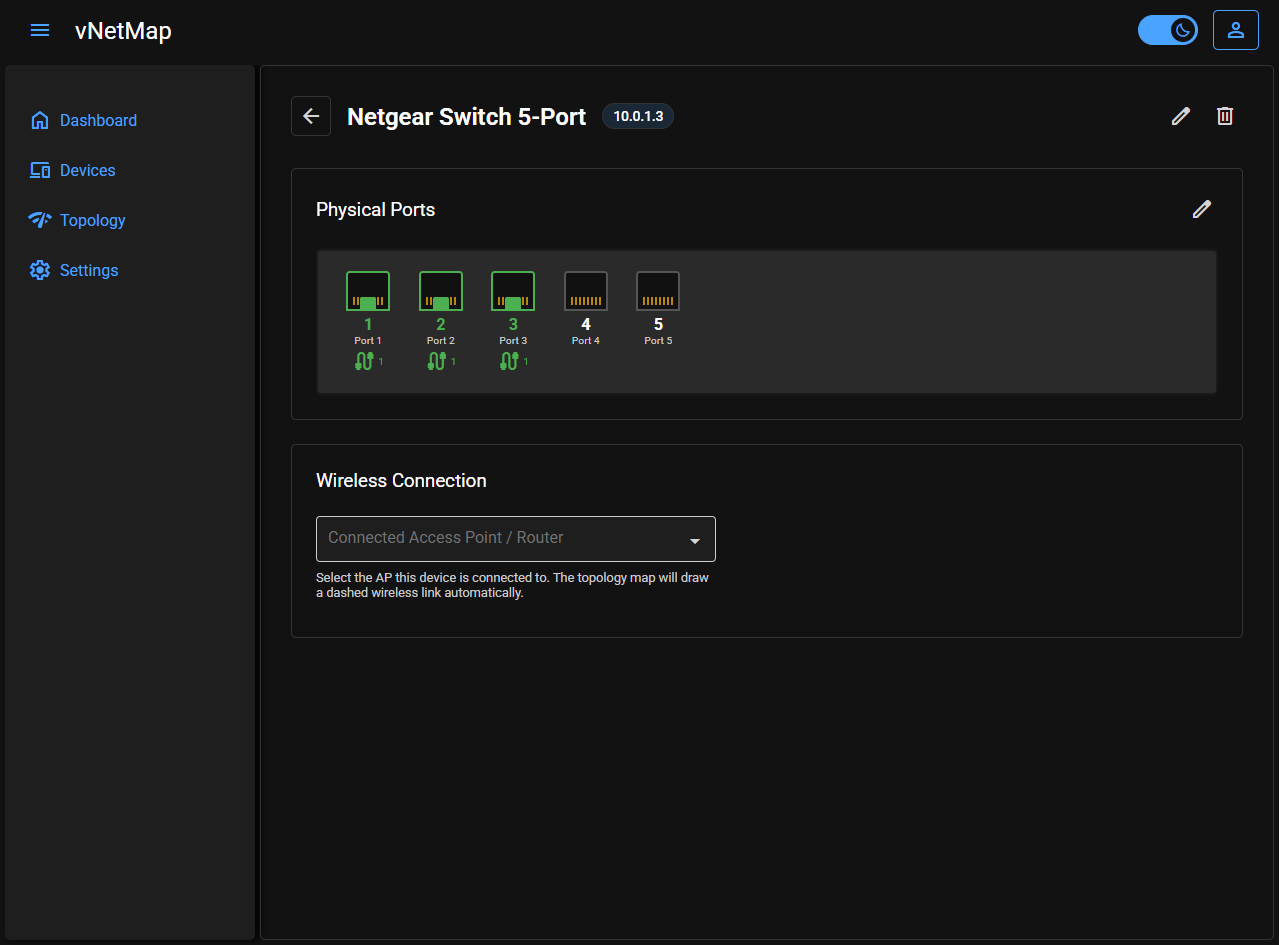
Document the path from switch port to patch panel to wall outlet. Bulk-generate ports, set custom aliases and see connection states. You maintain the links; automatic detection via SNMP/LLDP is on the roadmap.
One workspace per client
Organizations and workspaces with roles (organization: Owner, Admin, Member; workspace: Admin, Viewer). Invite teammates with a shareable link.
Live status
See which devices and agents are online or offline, based on their last check-in.
Interactive topology
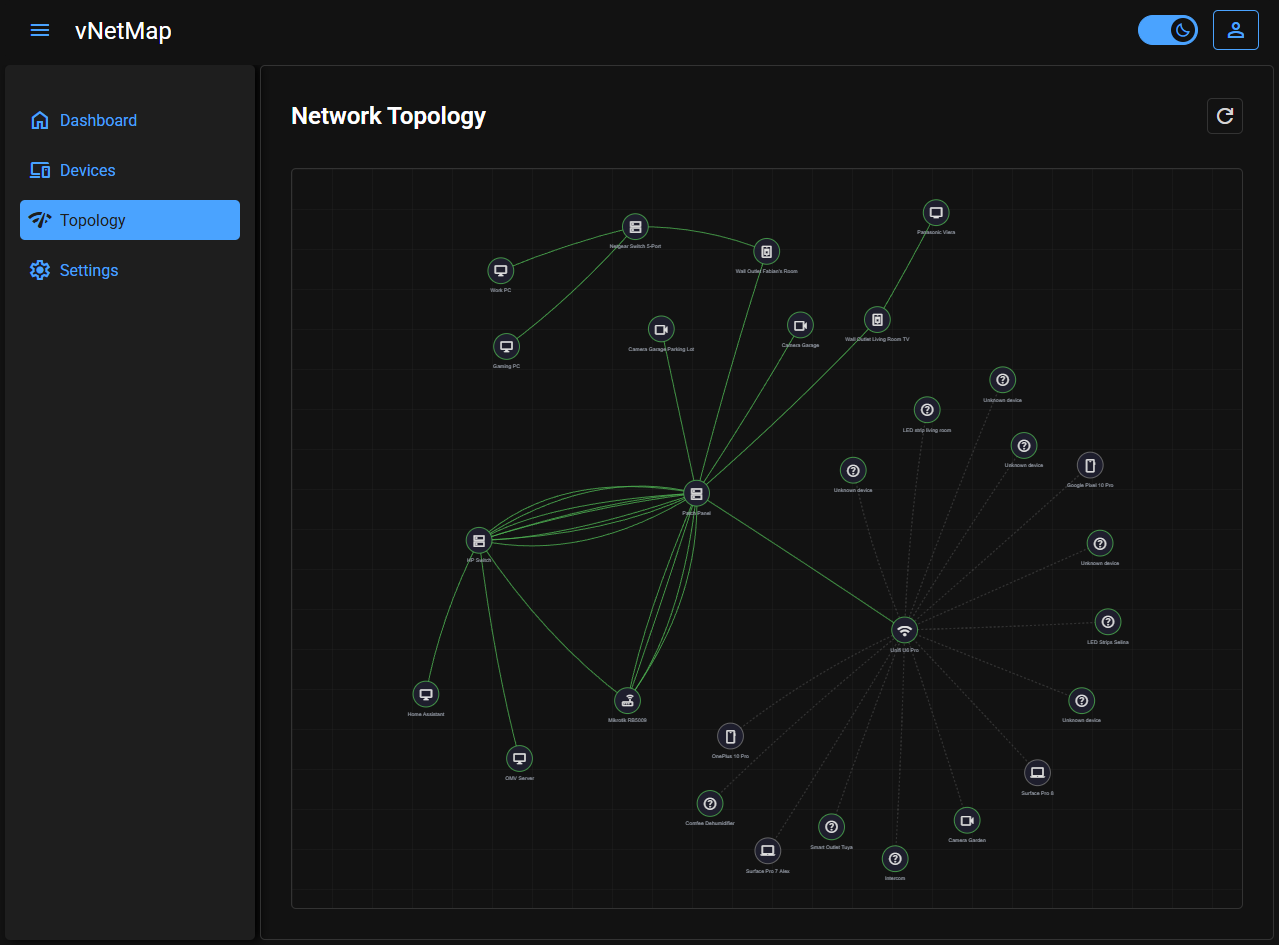
Switches, routers, access points and endpoints on one map, including clients nested behind access points and wireless links.
Current limitations
- Cable paths are linked manually; automatic SNMP/LLDP discovery is planned.
- Hostname detection depends on local name resolution (mDNS, NetBIOS, DNS) and can fall back to bare IP addresses.